From IT Audit to Action: Turning Findings into a Business-Ready Blueprint
Most companies invest in IT audits or assessments, expecting clarity and direction. You receive a detailed report full of findings: outdated systems, misconfigured software, security gaps, and cost inefficiencies. But then what? You’re left with a checklist of issues, unsure which problems are urgent, which can wait, and how to align fixes with your business priorities. The technical report may highlight what’s wrong, but it rarely tells you what to do next.
This common frustration isn’t a reflection on the quality of the audit but a translation gap. Technical findings alone don’t automatically convert into actionable business decisions. That’s where IT infrastructure consulting and strategic advisory services come in.
By bridging the gap between technology and business, these advisors turn assessments into prioritized roadmaps that drive measurable outcomes, from cost efficiency and risk reduction to scalability and operational confidence.
This blog explores why most audits stall, how advisory translation solves the problem, and what a practical, actionable blueprint looks like. You’ll also see examples of real-world decisions and learn how to measure success in business terms, not just IT metrics.

Why IT Audits Alone Rarely Drive Change
Traditional IT audits are valuable for surfacing gaps and risks. They uncover misaligned software, security vulnerabilities, outdated hardware, and inefficiencies. However, reports often stop there. Without context or guidance, leadership is left asking: Which issues matter most? Where should we invest first? What tradeoffs are acceptable given budget or staffing limits?
There are several reasons audits fail to create momentum:
No Prioritization Relative to Business Goals
Audits list technical problems but rarely consider how each affects growth, revenue, or operational efficiency. You may end up addressing minor issues while critical gaps remain unaddressed.
Ideal Conditions Are Assumed
Recommendations often presume unlimited budgets or flawless staffing, which rarely match reality for small or mid-sized businesses. Without accounting for your actual constraints, the plan can feel unrealistic and overwhelming.
More Questions Than Answers
Audit findings highlight problems but do not provide sequencing, vendor guidance, or risk-based tradeoffs. You may leave the assessment unsure how to translate insights into actions that truly move the business forward.
Limited Business Context
Technical reports focus on infrastructure details and security checks without connecting them to your company’s strategy, growth stage, or operational priorities. This lack of context makes it difficult to decide which issues will deliver the most impact.
No Guidance on Implementation
Even when issues are identified and prioritized, audits rarely outline practical steps for execution. Leadership is left to figure out the “how” on their own, which can delay or derail follow-through.
Gartner’s 2025 survey of chief audit executives found that using data analytics in audit engagements led to materially improved outcomes only about half the time, even though 80 % of audit leaders want stronger results from their audit efforts.
Many leaders said they struggle to prioritize findings and decide where to invest resources most effectively. This highlights that awareness alone does not move the business forward and underscores the need for advisory support that translates findings into clear, prioritized actions.
The missing link is advisory translation, turning technical findings into clear, actionable business decisions. Without this step, even the most thorough audit becomes a static document rather than a roadmap to growth.
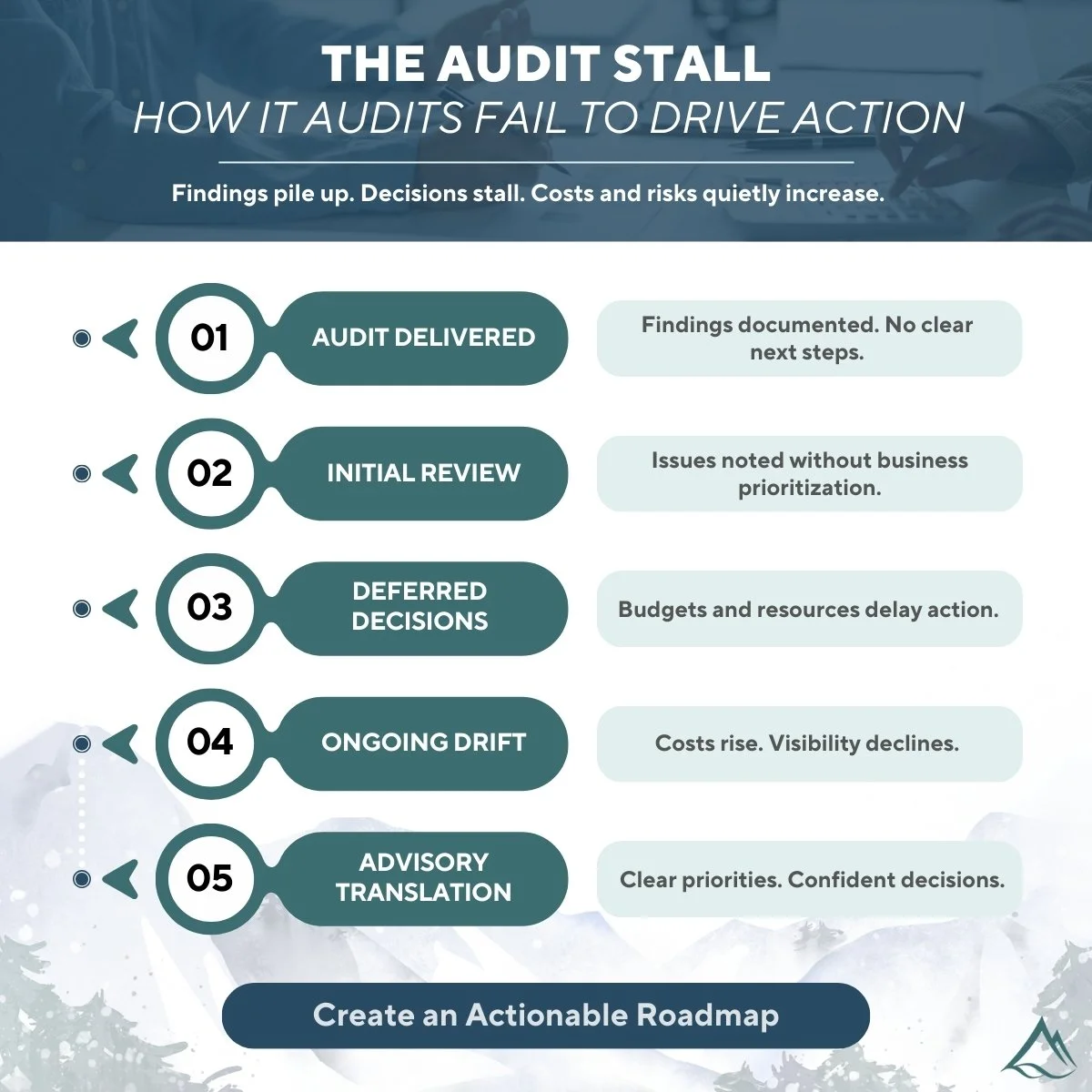
The Missing Layer: Translating Findings into Business Decisions
Advisory translation is the process of converting audit results into business-focused recommendations. It’s about connecting technical findings with strategic priorities, operational realities, and financial constraints.
Here’s how strategic advisors approach this process:
Map Issues to Business Goals.
Instead of simply noting outdated software, advisors assess how system gaps impact sales, operations, or customer support.Separate Urgent Risks from Long-Term Improvements.
Immediate threats to security or compliance are flagged, while enhancements for efficiency or scalability are scheduled strategically.Identify Misaligned Spending.
Overlapping services or underutilized software are consolidated or eliminated to free resources for higher-impact investments.Design Solutions Around Operational Realities.
Recommendations reflect your team’s capabilities, budget, and workflow, ensuring that changes are feasible and sustainable.Provide Actionable Timelines and Milestones.
Advisors break down initiatives into manageable steps, helping you track progress and make informed decisions at each stage.
A 2025 survey by GTIA found that 80 % of SMBs recognize significant room for improvement in how they use technology to support business goals, including strategy, planning, and execution. Many companies struggle to translate technical findings into prioritized actions that deliver measurable business value.
Leadership often feels uncertain about where to start or how to allocate limited IT resources effectively. This highlights that awareness alone does not create progress and underscores the need for advisory support that translates findings into clear, actionable business decisions.
Without this step, even the most thorough audit can remain a static document rather than a roadmap to growth.

What an Actionable Technology Blueprint Looks Like
An actionable technology blueprint is not just a report. It is a decision-making tool that helps you turn audit findings into clear, manageable steps. MountainTop Solutions works with leadership to create blueprints that translate technical observations into priorities you can act on immediately. This ensures that assessments do more than highlight problems—they guide you toward meaningful business outcomes.
A blueprint provides leadership with:
Clear Sequencing and Priorities.
You know which initiatives to tackle first and which can wait without risking operations.Tradeoff Guidance.
Advisors highlight what is critical versus optional and outline budget and staffing implications.Alignment with Growth Stage and Risk Tolerance.
Recommendations match your company’s size, revenue stage, and appetite for operational or financial risk.Decision-Enabling Guidance.
Rather than creating more analysis, the blueprint allows you to act confidently.Integrated Vendor and Resource Planning.
Advisors provide insight on which vendors to engage, contract considerations, and how internal resources can be allocated efficiently.
In practice, a blueprint may combine visual timelines, scoring for urgency and impact, vendor recommendations, and cost estimates. By focusing on outcomes instead of just technical findings, leadership can manage projects, budgets, and vendor relationships without being bogged down by jargon or unnecessary complexity.
This approach is central to IT infrastructure consulting, where the goal is not just identifying problems but building infrastructure that supports growth, efficiency, and security.

Practical Examples of Translation in Action
Advisory translation is most tangible when applied to real-world decisions. Consider these anonymized examples:
Reallocating Spend
A company discovered overlapping software licenses in multiple departments. By consolidating platforms, advisors freed budget to invest in workflow automation tools that improved team productivity.
Vendor Consolidation
Multiple telecom and cloud vendors were creating complexity and recurring billing errors. Advisors recommended reducing the vendor base and renegotiating contracts, resulting in lower costs and fewer administrative headaches.
System Redesign
An SMB was struggling with fragmented infrastructure that slowed onboarding and reporting. Advisors mapped workflows to technology, redesigned the system, and improved compliance and operational efficiency.
Security and Compliance Optimization
A business with scattered security tools and inconsistent policies faced rising compliance risks. Advisors standardized controls, consolidated security platforms, and implemented monitoring protocols, reducing risk and simplifying audits.
Process Automation
An organization spent excessive time on manual reporting and approvals. Advisors identified repetitive tasks, implemented workflow automation within existing systems, and freed staff to focus on higher-value activities, improving both speed and accuracy.
Each of these examples illustrates how translating audit findings into business-aligned actions drives measurable benefits, from cost savings to faster decision-making and reduced operational friction.

Measuring ROI in Business Terms
Evaluating the success of IT initiatives goes beyond tracking uptime or server performance. The business impact is what matters most:
Reduced Operational Friction.
Processes flow more smoothly when technology aligns with workflows.Improved Budget Predictability.
Advisory-led decisions help you know where your money is going and what each investment achieves.Fewer Vendors to Manage.
Consolidation reduces administrative overhead and strengthens leverage during negotiations.Faster Executive Decision-Making.
With clear priorities and actionable plans, leaders spend less time debating and more time executing.Infrastructure That Supports Growth.
Systems are designed to scale with the business rather than constrain it.
Forrester’s 2025 SMB Technology Performance Study found that companies implementing advisory-led IT initiatives reported measurable improvements in operational efficiency and budget predictability within the first year. The study highlighted that clear, business-focused guidance allowed leadership to prioritize high-impact projects and reallocate resources more effectively.

Why Strategic Advisors Outperform One-Time Assessments
There is a significant difference between one-off audits and ongoing IT infrastructure consulting, and MountainTop Solutions exemplifies this approach:
Continuous Translation and Prioritization.
As your business changes, we update recommendations to ensure your roadmap stays aligned with your current priorities and operational realities.Vendor-Agnostic Perspective.
MountainTop evaluates technology based on what fits your business needs, not on vendor incentives, helping you reduce risk and make decisions with confidence.Business-Phase Alignment.
Guidance is tailored to your company’s growth stage, budget, and operational capacity, ensuring recommendations are practical and achievable.Hands-On Support and Escalation
Strategic advisors remain engaged beyond the assessment, coordinating with vendors and providing guidance when challenges arise so you can focus on running your business.
By combining technical expertise with real-world operational experience, MountainTop ensures that technology decisions are proactive rather than reactive. This approach gives you confidence that each investment aligns with both immediate needs and long-term goals, and transforms audit findings into actions that drive measurable business outcomes.
Turning Insights into Action
IT audits reveal what’s broken, but awareness alone rarely drives results. Strategic IT infrastructure consulting turns those findings into a business-ready blueprint that prioritizes actions, guides decisions, and supports growth.
By mapping technical gaps to real-world business objectives, reallocating spend to high-impact areas, consolidating vendors, and redesigning systems to reduce friction, advisors help you achieve measurable ROI.
If you are ready to move beyond awareness and start turning IT insights into practical, high-impact actions, book a call with MountainTop Solutions today and see how a business-ready technology blueprint can transform your operations.